
Recipe Mutiny steals recipes from food blogs and recipe sites. Then we publish them. With credit (Naturally).
Wednesday, May 1, 2019

 Get Recipe!
Chicken Piccata Pasta
Continue reading "Chicken Piccata Pasta" »
from Simply Recipes http://bit.ly/2GNZ2SS
via IFTTT
Tuesday, April 30, 2019
Your Espresso Addiction Stems from an Ancient Ceremony
It’s hard to imagine life before espresso, but believe it or not, there was once a tired, latte-less time. The first basic prototype for an espresso machine was invented in Turin, Italy in the 1880s, though it looked more like a hot-water heater than the blinged-out coffee hotrods we see in cafés today, and for good reason—that’s basically all it was, a steam boiler designed to heat water in a closed chamber, which would also build up a reserve of pressure that a waiter or bartender could release over a bed of finely ground coffee.
Those early machines, including the 1905 patent by Luigi Bezzera that modernized and streamlined the design and added more functionality for the human making the coffee (they were not known as baristas until much later), are interesting enough on their own—and we’ll briefly discuss how they work in a moment—but the really interesting thing about the history of espresso comes from tracing the story of coffee drinking all the way from Ethiopia and piecing together how in the world it made its way to Italy.
Ethiopian Origins: The Coffee Ceremony
The beverage we know as coffee has a somewhat mysterious origin, but historians know that first the leaves and the coffee fruit were consumed in and around the area now known as Ethiopia, possibly for hundreds of years, before anybody thought to clean and roast the seeds, pulverize them, and mix them with hot water. At some point in the 15th century, spice traders from the Arabian Peninsula, including the area now recognized as Yemen, encountered coffee plants while traveling through Ethiopia in search of trade, spices, and slaves. These traders were found inspiration for creating the hot, bittersweet, and caffeinated elixir we know as coffee most likely in mystical Islamic beliefs about alchemy, the principle of transforming something worthless into something valuable, as a sign of God’s love for humankind. Well, certainly if anything is a sign that God loves us, it’s coffee. Who’d have thunk that these little grassy-smelling seeds could transform into something so miraculous with a little heat, elbow grease, and water?

Shutterstock
This first Ethiopian coffee concoction was originally prepared—and still is, in a traditional service—as a kind of ceremony. It’s conducted by the woman who is the head of a household, and she will call friends, family, and neighbors to join at the table. The coffee seeds are washed and then roasted in a metal pan over a fire, until they turn dark chocolate brown and begin to crackle and smoke. The pan is removed and in its place a pot called a jebena will be filled with water and put on the heat to boil. Often the woman will also toast grains or pop corn to eat with the coffee. While the water heats, she grinds the beans with a mortar and pestle, and then she will add the grounds to the water when it’s ready. The coffee brews for a few minutes before she slowly pours off the liquid in small portions into demitasse like cups, passing them around for the folks who have gathered. In traditional ceremonies, the grounds will be brewed three symbolic times, with each serving poured for the guests; the whole process can take an hour (or more), depending on the company.
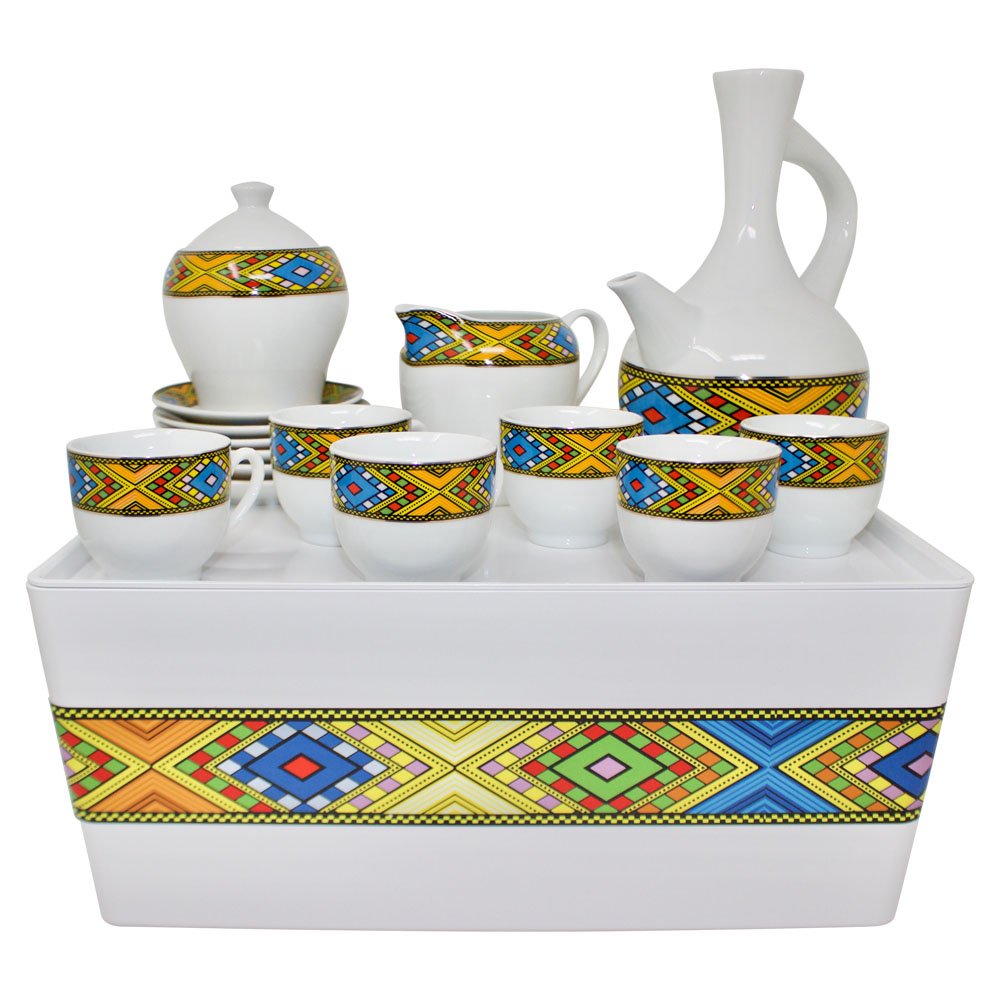
Ethiopian Jebena and Coffee Cup Set, $119 on Amazon (plus shipping)
Sip in ceremonial style.
Before long, this version of our favorite drink became a staple of social and religious life throughout Ethiopia, Eritrea, and with spice traders and religious Sufi Muslims, but in order for it to really catch on, the process needed a bit of a boost.
Next Steps: Arabic Coffee
Knowing what we now know about the first coffee drink, it will probably be a little easier to connect the dots to what came next: Arabic coffee, sometimes also known as Turkish coffee because of its geographical and cultural associations with the Ottoman Empire. In cities throughout the Arabian Peninsula, then a huge trading hub for the Ottomans, coffee became a staple not of domestic life as in Ethiopia, but in business and political life, outside of the home and in male-dominated spaces. Men would sit in circles on rugs at “coffee houses” and take coffee together to make deals and discuss finances.
Of course, this meant that the men also needed to hustle back to work, so an hourlong ceremony wasn’t going to cut the mustard—even in the days before time clocks and HR departments. In order to speed things up while still retaining some of the legacy and lore of coffee’s alchemical process, a new brewing pot was invented (called an ibrik or a cezve) with a long handle, in which coffee that’s been pulverized to a very fine powder can be boiled in water over a flame more quickly, poured out into small cups, and the grounds re-used as needed. Typically, the slurry of coffee grounds and water were brought to a vigorous boil three times before being doled out to patrons—thereby keeping some of the symbolic aspects of the coffee while also making a faster, stronger drink. The resulting liquid is thick, intense, and very bittersweet—much more pungent in flavor and concentration than the delicate, almost tea-like coffees of the Ethiopian ceremony.
Small portions of coffee brewed strong, dark, and fast: Can you guess where this is headed?
Related Video: How to Pull the Perfect Espresso
Italian Trade and Industrial Revolution (The Need for Speed)
One of the main ports of call along the Ottoman spice route was the Italian city of Venice, which is also a major port city positioned on the Red Sea—a nearly direct route for traders to enter Europe and sell their goods. Starting in the 17th century, Italians would have been exposed to the coffee-drinking cultures that came off the ships, with coffee beans sold as an exotic item alongside garlic and cardamom, etc. Soon, Italians were drinking something like the Arabic coffee, a thick, dense brew that provided a jolt of energy and filled up an empty stomach. As Europe modernized and industrialized, coffee became a necessity to keep production flowing, replacing its status as more of a cultural, religious, or social drink and turning it into fuel for the working classes.
In the late 19th and early 20th century, Italy’s industrial revolution was in full force and the urban centers were booming with businesses, factories, and, of course, lots of overworked, underfed, and underpaid employees. Coffee was essential for productivity, but brewing it in the preferred style took took too long and interrupted work too much. Enter Luigi Bezzerra, credited with patenting the first fully functional steam-powered espresso machine. The beast of a boiler was capable of dispensing pressurized hot water over finely ground coffee in a matter of moments, creating a thick, bittersweet brew that immediately became the craze. “Espresso” was born, though whether the name implies the speed or the individual nature of the brews is still debated these more than 100 years later.

Shutterstock
One thing that’s not up for debate about espresso, however—and maybe the only thing that’s not up for debate about it—is that it’s changed the way that people have consumed coffee around the world. Italian immigrants brought espresso along with them as they came to the United States, and as early as 1945 a food columnist for New York Herald-Tribune was describing an “exotic” drink found in one of the cozy Italian cafés of the East Village. “Cappucino [sic] is a cup of espresso with steam-heated milk floating lazily over the surface, and that delicate bouquet is just the merest pinch of ground cinnamon,” she wrote, going on to quote the café owner as saying that the think is something “the ladies like very much.”
Cut to: Espresso Today
Throughout the late 1950s and into the 1960s, espresso bars became countercultural hangouts where musicians, poets, and amateur philosophers gathered over black espresso to argue, swap ideas, and collaborate. In the 1970s and 1980s, the drink became emerged as a status symbol for upwardly mobile types who had traveled to Europe and brought back “refined” tastes from holiday, flaunting sophistication by ordering espresso at bars and restaurants and paying high prices for what had once been working-class fuel.
In the early 1980s, Howard Schultz—already the major player at a small but growing Seattle chain called Starbucks—took a trip to Milan and fell in love with the flavor of espresso and the local color in the espresso bars. When he came home, he quickly began transforming Starbucks into an Americanized (that is to say accessible, fast-food-like, and both affordable and seemingly “upscale”) institution, playing on the comfort of the coffeehouse and the chic air that Italian-style drinks offered.
The rest, as they say, is history: Today, espresso is everywhere from the most high-end boutique coffee shops to the average corner store. It can be expensive single-origin special-process coffee at a third-wave café, or it can be the base of any number of fast-food milkshake-like treats ordered across a drive-through window. It’s also easier than ever to make at home, with kitchen units costing anywhere from a couple hundred bucks all the way to a couple thousand.
There’s good news, though: If you need to justify your several-shots-a-day habit, just remind yourself you’re partaking of an ancient ceremony and, you know, paying tribute to the mysterious alchemy of coffee. Liquid gold, baby! Liquid gold.
Triple Shot
All featured products are curated independently by our editors. When you buy something through our retail links, we may receive a commission. For more great hand-picked products, check out the Chowhound Shop.
from Food News – Chowhound http://bit.ly/2J3Xwig
via IFTTT
The Best Mexican Cookbooks for Cinco de Mayo (and Every Day)

While Cinco de Mayo may be one of the most misunderstood holidays in the U.S.—it’s often confused with Mexico’s Independence Day—it’s the perfect occasion to delve into the traditional cuisine of our closest neighbor south of the border. Sure, you could stick with the most obvious choices: guacamole, tacos, ceviche, and margaritas. But Mexican food is much more varied and nuanced than you may realize, and each region of the country has its own specialties that are well worth exploring.
Instead of serving the same old salsa, why not whip up a mole sauce that will make your guests go weak in the knees, stir up a cocktail that highlights the earthiness of mezcal, or mix up some masa to make tamales from scratch? Whether you’re vegan, gluten-free, paleo, keto, or a true omnivore, there are thousands of recipes to make this holiday más delicioso.
To help you narrow it down, we’ve put together a list of the best Mexican cookbooks for Cinco de Mayo (or, really, any occasion).
“The Essential Cuisines of Mexico” by Diana Kennedy, $12.84 on Amazon

Amazon
Don’t let the name fool you. Although Diana Kennedy was born and raised in the UK, she is widely recognized as one of the world’s foremost experts on Mexican cuisine. She’s also the recipient of numerous awards, including the James Beard Award for Cookbook Hall of Fame. So if you’re looking to learn from one of the greats, this particular collection of recipes, which also covers history, cultural traditions, social customs, and techniques by region, is your best bet. In fact, “The Essential Cuisines of Mexico” is actually three of her bestselling cookbooks (“The Cuisines of Mexico,” “Mexican Regional Cooking,” and “The Tortilla Book”) combined, with some newly-added recipes. Buy Now
“Nopalito: A Mexican Kitchen” by Gonzalo Guzmán with Stacy Adimando, $20.40 on Amazon

Amazon
Speaking of James Beard Awards, Nopalito was the winner for Best International Cookbook in 2018. Gonzalo Guzmán, who grew up in the small village of Catemaco in Veracruz, Mexico, is the co-owner and chef of celebrated restaurant Nopalito, which has two locations in San Francisco. As you may expect, many of the dishes included here come straight off the menu, including Ceviche Verde de Pescado y Calamari, Quesadillas de Espárragos con Salsa de Cilantro, Pozole Rojo, and Carnitas. Recipes for snack foods, salsas, drinks, and desserts are also included.Buy Now
“Paletas: Authentic Recipes for Mexican Ice Pops, Shaved Ice & Aguas Frescas” by Fany Gerson, $13.99 on Amazon

Amazon
Born and raised in Mexico, Fany Gerson is a CIA-trained pastry chef and creator of La Newyorkina.While she focuses more on pastries in “My Sweet Mexico,” this collection of recipes is an homage to the paleterías of her childhood. Think cool, refreshing, fruity, and thirst-quenching. With just a few ingredients and the right instructions (courtesy of Gerson, of course), you could be turning out simple yet satisfying treats such as Quick Coconut Ice Pops, Strawberry-Horchata Shaved Ice, and Cucumber-Lime Cooler to beat the heat all summer long.Buy Now
“Decolonize Your Diet: Plant-Based Mexican-American Recipes for Health and Healing” by Luz Calvo and Catriona Rueda Esquibel, $18.32 on Amazon

Amazon
For college professors and life partners Luz Calvo and Catriona Rueda Esquibel, what began as a personal exploration of vegetarianism focused on indigenous Mexican cuisine turned into a movement to reclaim Mesoamerican traditions. But you don’t have to be vegan or vegetarian to appreciate a plant-based diet, and these recipes are anything but boring. Cauliflower Ceviche, Chipotle Pumpkin Soup Alchemy, Sweet Potato Tacos with Red Cabbage Slaw, and Red Enchiladas Stuffed With Potatoes, Greens, and Pumpkin Seeds are just a few of the offerings. You’ll also find numerous options for making tortillas, salsas, tacos, and beans. Plus, there’s a whole section just on breakfast foods.Buy Now
“Yucatán: Recipes from a Culinary Expedition” by David Sterling, $60 on Amazon

Amazon
Winner of several awards, including Best Cookbook of the Year and Best International Cookbook by the James Beard Foundation in 2015, this cookbook is a celebration of cuisine from Yucatán, Mexico’s Southeastern region, where chef and author David Sterling runs Los Dos, a cooking school based in Mérida. Whether you’re looking to impress your guests with an elaborate five-course feast or simply throw something together for a one-pot meal, there’s something for everyone here. Along with the colorful photos, you’ll also appreciate learning a bit about this area’s history and culture.Buy Now
“Mezcal: The History, Craft & Cocktails of the World’s Ultimate Artisanal Spirit” by Emma Janzen, $17 on Amazon

Amazon
Rooted in indigenous Nahuatl culture, mezcal is made from the agave plant—like tequila—but has a very different flavor profile. It’s less sweet, more smoky, and often made in small batches by hand. Emma Janzen’s book, which was nominated for a James Beard award in 2018, explores every aspect of this (until recently) underappreciated Mexican liquor, from its history to how it’s produced. She not only breaks it down by region, terroir, variety, and maker, but also provides recipes for her favorite mezcal cocktails. Buy Now
“The Mexican Slow Cooker: Recipes for Mole, Enchiladas, Carnitas, Chile Verde Pork, and More Favorites” by Deborah Schneider, $15.99 on Amazon

Amazon
Mexican cuisine—like many others—often requires a ton of prep work and many different steps. But that doesn’t mean you can’t find “set it and forget it” recipes, like this comprehensive collection of classics from Deborah Schneider. The contents are separated into five main sections: soups; mains and guisados (aka stews); street food favorites; basics; rice, beans, and other sides; and desserts. From menudo to enchiladas to flan with caramel, you’ll be surprised and delighted by how many dishes from south of the border you can make in your slow cooker.Buy Now
“My Mexico City Kitchen: Recipes and Convictions” by Gabriela Cámara with Malena Watrous, $22.48 on Amazon

Amazon
Hot off the presses, this new cookbook by restaurateur and chef Gabriela Cámara boasts lush photographs and enticing recipes based on reliable techniques and fresh ingredients. She provides detailed instructions on how to make your own tortillas and stories about her own family favorites, plus some of the most popular dishes (see her recipe for Pescado a la Talla) to be found at her Mexico City seafood restaurant, Contramar, and Cala in San Francisco. While Cámara covers everything from basics to breakfast to dessert, seafood-loving home cooks will especially appreciate what she has to offer.Buy Now
“Fiestas: Tidbits, Margaritas & More” by Marcela Valladolid, $13.51 on Amazon

Amazon
Whether you’re planning a small gathering or a huge shindig, Marcela Valladolid has got you covered with this cookbook full of advice on entertaining and recipes for cocktails and finger foods. She knows how to put a modern twist on classic dishes to keep things interesting. With options like Picadillo Lettuce Cups, Chickpea Ceviche Tostadas, White Peach Sangria, Orange-Cinnamon Sours, Coconut-Lime Cheesecake Bites, and Dulce de Leche Cream Puffs, your guests will definitely be impressed.Buy Now
All featured products are curated independently by our editors. When you buy something through our retail links, we may receive a commission. For more great hand-picked products, check out the Chowhound Shop.
from Food News – Chowhound http://bit.ly/2GVJEFm
via IFTTT
Give Your Mom the Perfect Cookbook Based on Her Personality

Mother’s Day is approaching fast and we don’t need to remind you that moms are complex and amazing; whether they stay at home, work full time, or freelance, they are hard-working women. Rather than chocolates or a bouquet of flowers that will eventually wither away, why not consider cookbooks? Perhaps finding a cookbook that would complement her strengths could be clever and fun. Maybe she was an art history major in college or is obtaining a second degree in higher ed. Whatever your mom is into, it’s fun to choose a cookbook that aligns with her interests. Below is a list of options geared to a few of moms’ various personalities to help you along.
Best Cookbook for the Science Mom
“The Food Lab: Better Home Cooking Through Science” by J. Kenji López-Alt, $33.91 from Amazon

Amazon
For your technical-minded mom, she may favor a cookbook that offers thoughtful recipes and explores the science of cooking and food. Maybe she’s more interested in how to achieve the perfect char on a seared steak or how to make the perfect poached egg (hint: the freshness of the egg is key). Awarded James Beard Best Cookbook, “The Food Lab” uncovers how to create delicious food through a scientific lens.Buy Now
Best Cookbook for the Art Mom
“Modern Art Desserts: Recipes for Cakes, Cookies, Confections, and Frozen Treats Based on Iconic Works of Art” by Caitlin Freeman, $15.17 from Amazon

Amazon
For the artsy mom, she will appreciate not only a cookbook filled with delicious desserts, but a book that showcases artistic expression. Help transport your mom back to her collegiate art history days with “Modern Art Desserts.” Blue Bottle Coffee chef Caitlin Freeman puts her expertise to work by recreating desserts inspired by Modern Art masterpieces. Matisse Parfaits, Koon’s White Hot Chocolate, and Mondrian Cake will delight and inspire your mother to think of her kitchen as her newest art studio.
Buy Now
Best Cookbook for the Team Mom
“Feed Your People: Big-Batch, Big-Hearted Cooking and Recipes to Gather Around” by Leslie Jonath, $27.16 from Amazon

Amazon
Whether it’s band practice, the hockey team, or the cast party wrap event, this mom is adept at feeding a crowd and hosting hungry kids. She needs a cookbook that is simple to use and features recipes that are true crowd-pleasers. Large-batch recipes like Grandma Salazar’s Chile Verde and Nepalese Momos will add some ethnic spice to the typical lasagna dinners and Dunkin Donuts’ pre-game breakfasts. Recipe contributors include culinary masterminds Alice Waters, Deborah Madison, Gonzalo Guzman, and many more. (See the Grand Aioli with Roasted Salmon recipe from the cookbook, and the Cherry Tomato Tart with Anchovies and Garlic Confit recipe too.)Buy Now
Best Cookbook for the Healthcare Mom
“The How Not to Die Cookbook: 100+ Recipes to Help Prevent and Reverse Disease” by Michael Greger M.D. and Gene Stone, $20.39 from Amazon

For the mother who works or practices in the healthcare world, nutrition is probably an important factor when cooking and feeding a family. It’s no secret that diet is a driving force in our overall health and your intelligent mom may gravitate towards another professional in the field, like Dr. Greger, whose NutritionFacts.org is a wild success. Even if nutrition’s not her day job, but just something she’s passionate about, keep her healthy and glowing with Superfood Breakfast Bites and Stuffed Portabellos with Herb Mushroom Gravy. Sample menus are included to keep her motivated and on track for a lifetime of nutritious eating.Buy Now
Best Cookbook for the Corporate Mom
“Dinner: Changing the Game” by Melissa Clark, $20.44 from Amazon

Amazon
For the mom who is high on that corporate ladder, she may take a more serious and focused approach to food. In fact, maybe her assistant even schedules in chunks of time for cooking and eating. She needs a practical cookbook like New York Times’ food columnist Melissa Clark’s “Dinner.” This cookbook focuses on straightforward dinner recipes without the hassle of creating multiple side dishes. Clark’s book features more than 200 recipes based around a main ingredient like chicken or tofu—and pizzas. Recipes such as Five Spice Duck Breasts with Crisp Potato Cakes, and Asian Grain Bowl with Roasted Shiitakes, Tofu, Brussels Sprouts, and Miso Dressing will be straightforward, filling, and scrumptious.Buy Now
Best Cookbook for the Blogger Mom
“Half Baked Harvest Cookbook: Recipes from My Barn in the Mountains” by Tieghan Gerard, $20.39 from Amazon

Amazon
Is your mom an aspiring writer? Does she stay up late working on her Squarespace site and researching SEO for those matcha coconut lattes she’s been blending? Well perhaps mountain food blogger Tieghan Gerard’s “Half Baked Harvest” cookbook will inspire your mom. Based off of her popular blog, Gerard’s new cookbook features recipes from her rustic barn and kitchen in the mountains. Buddha Smoothie Bowls; Fancy Toasts, Eight Ways; and Earl Gray Blueberry Muffins with Cinnamon Streusel will galvanize your mom to go from blogger to book author, especially with stunning photos alongside each mouthwatering recipe.Buy Now
Best Cookbook for the Gardener Mom
“Grow Cook Eat: A Food Lover’s Guide to Vegetable Gardening, Including 50 Recipes, Plus Harvesting and Storage Tips” by Willi Galloway, $21.75 from Amazon

Amazon
For the mom who loves wholesome food, shops at the local farmers’ market, and may even have her own vegetable patch in the backyard or window box, she may appreciate a vegetable-driven cookbook. “Grow Cook Eat” illustrates 50 garden-to-table recipes and instructs gardeners–from the novice to the refined– on best practices for growing your own sustainable, edible garden.Buy Now
Best Cookbook for the Back-to-School Mom
“The Instant Pot Bible: More than 350 Recipes and Strategies: The Only Book You Need for Every Model of Instant Pot” by Bruce Weinstein and Mark Scarbrough, $13.38 from Amazon

Amazon
For the mom who is hustling at night school or glued to her computer for online courses to finish a degree, she will need something that’s easy and quick. A best-selling cookbook, “The Instant Pot Bible” is comprised of more than 350 quick-cooking recipes for that Instant Pot you bought mom during the holidays. She can whip up hot breakfasts like Cinnamon Apple Oatmeal, stews like Not-Your-Jewish-Grandmother’s Sweet-and-Sour Soup, and other delicacies in just minutes with very little planning to allow her to tend to her studies and focus on where she will hang her newest framed degree in the house.Buy Now
Best Cookbook for the Gourmet Mom
“Institut Paul Bocuse Gastronomique: The Definitive Step-by-Step Guide to Culinary Excellence” by Institut Paul Bocuse, $48.87 from Amazon

Amazon
For the mom who is a true epicurean, she will appreciate a cookbook that’s knowledgeable, in-depth, and culinarily-challenging. Enter the “Institut Paul Bocuse Gastronomique,” a fully illustrated tome demonstrating how to prep, cook, and serve 70 recipes for professional chefs and aspiring cooks. With over more than 1,500 “how to” photographs, this book is an essential reference for any cook who wants to tackle classic and contemporary cuisine, from pan frying a rack of veal to preparing monkfish tail.Buy Now
All featured products are curated independently by our editors. When you buy something through our retail links, we may receive a commission. For more great hand-picked products, check out the Chowhound Shop.
from Food News – Chowhound http://bit.ly/2XZkYlc
via IFTTT